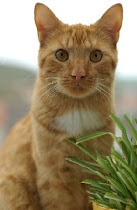
Credits: July Lifes Abundance Newsletter, Thursday, 26 July 2012 16:53 by Dr. Jane Bicks
Cats are enigmatic creatures.
Having an appreciation for their motivations will not only help you to develop a deeper bond, it could make your cat healthier, too.
Feeding your feline optimal nutrition not only requires an understanding of your cat’s unique nutritional needs, but also of their feeding behavior. In fact, understanding the nuances of feline consumption can help combat one of the most common feeding disorders in cats - obesity.
When it comes to feeding behaviors, domestic cats aren’t vastly different than their wild cousins.
Felines are so fundamentally predatory that they will actually stop eating a meal to initiate a new hunt. This instinctual strategy evolved in the wild over the course of millenia to maximize food availability. This is why, if a cat even sees a mouse, she feels compelled to catch it.
Domesticated cats exhibit this same hunting impulse, and sometimes pet parents mistake feline hunting behavior as an expression of hunger. However, it’s simply a manifestation of their predatory instinct.
It might amaze you to learn that cats in the wild consume 10-20 small meals per day! And 40% or more of the diet of feral domestic cats consists of small rodents, but the typical mouse only provides a tiny amount of the daily energy requirement of an adult cat. In order to obtain enough calories, a cat must hunt throughout the day and night.
Generally speaking, domesticated cats demonstrate similar behavior, ‘snacking’ throughout the day on their kibble and canned food. The significant difference here is that prepared food features substantial calorie counts, especially compared to a field mouse.
With many indoor kitties adopting the couch-potato lifestyle, a sizable portion of the U.S. cat population is overweight or obese. A major concern that affects overall health, obesity was nearly unheard of in cats 100 years ago.
In a relatively short period of time, cats have gone from outdoor predators, constantly searching for small prey, to indoor loafers with a nearly constant supply of freely available food! No longer subjected to the daily hardships of environmental dangers (such as predators, rampant disease, increased risk of traumatic injury and at the mercy of the elements), cats are not only falling prey to obesity, they are suffering from collateral disorders like arthritis and diabetes. Simply by adopting new methods of providing sustenance, pet parents can not only help their indoor cats avoid obesity but also boredom … talk about a win-win scenario!
Unless your cat is hyper-vigilant at regulating her caloric intake, the amount of food for the day should be measured out to prevent overeating. Resist the temptation to ‘feed the empty bowl’.
A good reality check is readily available in the form of the Suggested Daily Amount listed on the back label of Life’s Abundance food bags. It’s important to note that neutered and sedentary cats have lower energy requirements than outdoor hunters or extremely active kitties.
Food intake should be adjusted according to a cat’s activity level, to help maintain an optimal body condition. Remember, a cat is at a good weight when you can feel ribs, but not see them. It’s always a good idea to discuss weight management issues with your veterinarian. Feeding your cat in a manner that mimics hunting can result in positive health benefits. Doing so will decrease boredom and increase exercise levels, helping to trim fat and build muscle tissue.
We encourage you to employ some of the following suggestions, provided by from the American Association of Feline Practitioners (catvets.com):
- Use a puzzle feeder or food ball to dispense food as a challenge. Or make your own homemade puzzle feeder by cutting holes into a taped-shut shoebox or empty two-liter bottle, either with holes large enough that she can paw kibble out, or kibble-sized holes that will dispense food as she bats the container around. Begin with easy-to-solve puzzles … as your smart kitty works out the chow challenge, introduce new, more difficult mealtime mystifiers. *Hide food throughout the house … be creative and change up locations frequently, effectively recreating a ‘scavenger hunt’.
- Throw kibble for your cat to chase, to mimic pursuit of prey.
- If you feed treats, make sure the calories for those treats are reflected in the total daily counts.
- Make sure all the members of your family are on the same page when it comes to curtailing feline obesity. That means, no duplicated feedings or treating.
- If your kitty stares at you with longing eyes during meal time, then feed the largest meal during that time to prevent begging.
- If your kitty pounces on you at night demanding to be fed, then feed the largest meal right before bedtime.
I truly believe that if you make the commitment to alter your feeding habits, you can make a big difference in the long-term health of your furry best friend. Thank you so much for all you do to make the world a better place for companion animals.
Sincerely,
Dr. Jane Bicks
###
The quality of cat food you feed is important to your Kitty's health and well-being. Healthy, happy cats make fewer trips to the Vet, too. We feed Life's Abundance Cat Food. It's healthy, wholesome and does not contain artificial colors or flavors. It does not contain animal byproducts, corn or what gluten. Your kitty will love Life's Abundance Kitty Food.
>>> Learn More and Order Lifes Abundance Kitty Food.
***